
Introduction
Chemical reactions involving highly reactive reagents often depend on the structure of the starting materials and the conditions under which they are carried out. One such reagent is triflic anhydride, also known as trifluoromethanesulfonic anhydride. It is widely recognized in organic chemistry for its strong electrophilic properties and its ability to introduce triflyl groups into suitable compounds.
A common question in synthetic chemistry is: Will triflic anhydride react with amines?
The short answer is yes. Amines can react with this reagent because their nitrogen atoms contain a lone pair of electrons that can participate in nucleophilic reactions. Depending on the type of amine and the reaction environment, the process may result in nitrogen triflylation or other reaction pathways.
Understanding this interaction requires consideration of the amine structure, the chemical properties of the reagent, and the possibility of competing reactions.
What Is Triflic Anhydride?
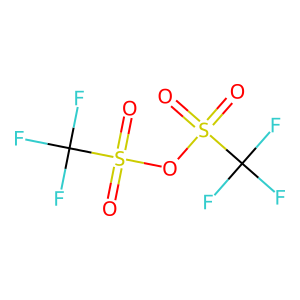
Triflic anhydride is a highly reactive organic reagent with the chemical formula (CF₃SO₂)₂O. Its systematic chemical name is trifluoromethanesulfonic anhydride, and its CAS Registry Number is 358-23-6.
The compound contains two trifluoromethanesulfonyl groups connected through an oxygen atom. This structure makes it an effective triflylating agent in organic synthesis.
Some of its important characteristics include:
Chemical formula: C₂F₆O₅S₂
Molecular weight: Approximately 282.14 g/mol
Physical state: Liquid
Appearance: Generally colorless to pale yellow
Chemical behavior: Highly reactive and moisture-sensitive
Primary application: Triflylation and activation of suitable functional groups
Because of its strong electrophilic character, the reagent can interact with several nucleophilic functional groups, including certain nitrogen-containing compounds.
Will Triflic Anhydride React with Amines?
Yes, triflic anhydride can react with amines. The nitrogen atom in an amine contains a lone electron pair, which can attack the electrophilic sulfur center of the anhydride.
This interaction can lead to the formation of an N-triflylated product, commonly described as an N-trifluoromethanesulfonyl compound.
However, the outcome is not identical for every amine. Primary, secondary, and tertiary amines have different structural characteristics, which influence their possible reaction pathways.
The overall reaction behavior also depends on factors such as solvent compatibility, moisture, steric effects, and the presence of other reactive functional groups.
How Does the Reaction Occur?
The reaction generally involves nucleophilic attack by the nitrogen atom on an electrophilic sulfur center.
During this process, the amine can interact with one of the triflyl groups, potentially resulting in the formation of a nitrogen-sulfonyl bond. The remaining portion of the anhydride participates in the associated acid-base chemistry.
The precise products depend on the amine structure and reaction conditions. Therefore, the reaction should not be treated as a universal transformation with identical outcomes for all amines.
Reaction With Primary and Secondary Amines
Primary and secondary amines contain nitrogen-bound hydrogen atoms. These compounds can undergo N-triflylation, producing nitrogen-containing sulfonyl derivatives.
Such transformations are relevant in organic synthesis because the introduction of a triflyl group can significantly change the electronic properties, acidity, and chemical behavior of the nitrogen-containing compound.
Nevertheless, competing reactions and the possibility of reagent consumption must be considered when evaluating a particular substrate.
Reaction With Tertiary Amines
Tertiary amines do not contain an N-H bond. Consequently, their reaction behavior differs from that of primary and secondary amines.
Their nitrogen atoms can still act as nucleophilic centers, allowing interactions with strongly electrophilic reagents. Depending on the molecular structure and reaction environment, transient adducts, ionic species, or other reaction products may be possible.
Therefore, the absence of an N-H bond does not mean that a tertiary amine is necessarily unreactive toward this reagent.
What Is the Triflic Anhydride Boiling Point?
The triflic anhydride boiling point is generally reported in the range of approximately 80–85°C at atmospheric pressure, although the exact reported value can vary between suppliers and reference sources.
For example, Thermo Fisher Scientific reports a boiling point of approximately 81–83°C, while FUJIFILM Wako lists a value of about 85°C.
This physical property is useful when evaluating the compound's general characteristics. However, boiling point alone does not determine its suitability for a particular chemical transformation.
The reagent is also highly sensitive to moisture and reacts violently with water. Its handling and storage therefore require appropriate chemical safety precautions.
What Factors Influence Its Reaction With Amines?
Several chemical factors can influence how triflic anhydride interacts with amines.
1. Amine Structure
The classification of the amine is important because primary, secondary, and tertiary amines have different nitrogen substitution patterns.
These structural differences influence the availability of nitrogen-bound hydrogen atoms, steric accessibility, and the possible products of the reaction.
2. Electronic Properties
The electron-donating or electron-withdrawing characteristics of substituents attached to nitrogen can influence the nucleophilicity of the amine.
A more nucleophilic nitrogen center may interact differently with the electrophilic reagent than one whose electron density is reduced by surrounding functional groups.
3. Moisture Sensitivity
Water is an important concern because triflic anhydride reacts vigorously with moisture.
Water contamination can consume the reagent and interfere with the intended chemical transformation. It can also create additional safety concerns.
4. Competing Functional Groups
A molecule containing an amine may also contain other nucleophilic groups. These functional groups can potentially interact with the reagent, affecting selectivity and the final product distribution.
Consequently, the behavior of a multifunctional organic compound cannot always be predicted by considering its amine group alone.https://researchchemshop.com/
Chemical Safety and Handling Considerations
Triflic anhydride is a highly corrosive and reactive chemical. Contact with water can cause a violent reaction, and exposure can result in serious skin and eye damage.
Its use requires appropriate institutional chemical safety procedures, suitable protective equipment, and properly maintained laboratory facilities.
The relevant supplier safety data sheet should always be consulted before handling the compound. Particular attention should be given to its incompatibilities, moisture sensitivity, exposure controls, and emergency procedures.
Conclusion
Triflic anhydride can react with amines because the nitrogen atom in these compounds possesses a lone electron pair capable of interacting with an electrophilic sulfur center.
Primary and secondary amines may undergo N-triflylation, while tertiary amines can display different reaction behavior because they lack an N-H bond. The actual outcome depends on the molecular structure, electronic properties, competing functional groups, and reaction environment.
Overall, the interaction between this reagent and amines is an important consideration in organic synthesis. Understanding the underlying chemistry helps explain its potential applications while highlighting the importance of selectivity and chemical safety.