
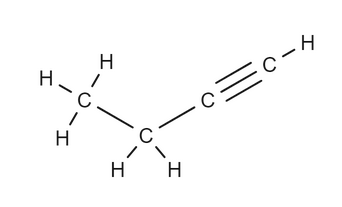
Understanding the molecular structure of organic compounds is an important part of learning organic chemistry. One common example is 1-butyne, a simple hydrocarbon belonging to the alkyne family. Its structure provides a useful way to understand carbon chains, triple bonds, and chemical naming conventions.
So, how many carbon atoms are in 1-butyne? The answer is four. The compound contains four carbon atoms and four hydrogen atoms, giving it the molecular formula C₄H₆.
What Is 1-Butyne?
1-Butyne is an organic compound classified as an alkyne. Alkynes are hydrocarbons that contain at least one carbon-carbon triple bond.
The name 1-butyne provides useful information about its molecular structure:
But-: Indicates that the molecule contains four carbon atoms.
-yne: Identifies the presence of a carbon-carbon triple bond.
1-: Shows that the triple bond begins at the first carbon atom.
This naming system helps identify the compound's basic structure without requiring a detailed molecular diagram.
How Many Carbon Atoms Does 1-Butyne Have?
1-Butyne contains exactly four carbon atoms.
Its molecular formula is C₄H₆, where:
C₄ represents four carbon atoms.
H₆ represents six hydrogen atoms.
The four carbon atoms form a continuous chain, with a triple bond between the first and second carbon atoms.
Its structural formula is:
CH≡C–CH₂–CH₃
This arrangement distinguishes 1-butyne from other four-carbon hydrocarbons with different bonding arrangements.
Understanding the Molecular Structure of 1-Butyne
The molecular structure of 1-butyne includes a terminal carbon-carbon triple bond. The triple bond is located at the beginning of the carbon chain.
The compound contains:
Two carbon atoms involved in the triple bond.
Two additional carbon atoms connected through single bonds.
Six hydrogen atoms attached to the carbon chain.
This structure gives 1-butyne its characteristic classification as a terminal alkyne.
What Is the Difference Between 1-Butyne and 3-Methyl-1-Butyne?
Both compounds belong to the alkyne family, but their molecular structures are different.
3-Methyl-1-butyne contains five carbon atoms, while 1-butyne contains four. The additional carbon comes from a methyl group attached to the main carbon chain.
Their molecular formulas are also different:
| Compound | Molecular formula | Carbon atoms |
|---|---|---|
| 1-Butyne | C₄H₆ | 4 |
| 3-Methyl-1-butyne | C₅H₈ | 5 |
This comparison demonstrates how small structural changes can affect the molecular formula and carbon count of organic compounds.
Why Is Carbon Counting Important in Organic Chemistry?
Carbon counting helps identify organic compounds and understand their molecular structures. It also supports the study of isomers, functional groups, and chemical nomenclature.
When examining a research chemical or another organic compound, understanding its molecular formula provides an important starting point for identifying its chemical composition.
Students and researchers can use systematic naming conventions to determine the number of carbon atoms and recognize the functional groups present in a molecule.
Final Thoughts
1-Butyne contains four carbon atoms and has the molecular formula C₄H₆. Its four-carbon chain includes a triple bond between the first and second carbon atoms, making it a terminal alkyne.
Comparing it with compounds such as 3-methyl-1-butyne also demonstrates how changes in molecular structure influence carbon count and chemical classification. Understanding these basic principles makes organic chemistry easier to follow and provides a foundation for studying more complex hydrocarbons.